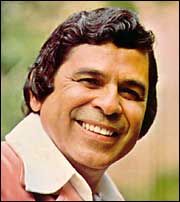
The career of Victor Manuel Aviles Rojas, known to all as Vitín Avilés, included successful internships for several of the most celebrated orchestras exponents of Afro-Caribbean music, collaborations record with as many stages as a soloist and successful. This admired singer was described by critics as demanding as good Latin as bolero. Put in plain words, this is a versatile performer and unique style. In the view of many of his followers, what was your greatest merit have been selected by Xavier Cugat on vocals for the album "Merengue by Cugat!" (CBS, DKC-10454), recorded in 1955, responding to the request of the Dominican dictator Rafael Leonidas Trujillo. Such production is still considered the most successful, globally, in the history of merengue.
Ironically, the name of Vitín reach Avilés full stellar lineup since 1974, after more than 30 years of intense artistic activity during which participated prominently in about 40 albums of traditional Cuban music and salsa, accompanied by bands and stellar sets. That year he recorded the album of boleros "Sing to Love" (Alegre, SALP-8676) that spawned three smash singles: "I was more fair" and "Why now?" (Bobby Capo) and "Temes" (de Tite Curet Alonso). This production is considered a classic of national discography.
Vitín Avilés was an intuitive musician. Never studied singing or an instrument. Born September 30, 1924 in the San Silvestre, Mayagüez. During his early youth he held the office of barber, he learned from his father, while making his first steps as an amateur in several radio programs in his hometown of Mayaguez WPRA. For his exceptional voice, he announced grandly as "Mojiquita" nicknames that are intended to compare with the acclaimed Mexican tenor Jose Mojica.
In 1943 began his professional career by joining the Hatuey Orchestra, led by pianist William Manzano. With that organization, which also featured Mon Rivera, it was about a year. And, after several months in Anacaona Orchestra, the Cuban pianist Obadiah Villalonga, decided to settle in San Juan, in 1944.
The Capital City soon found accommodation in the emerging band of trumpeter Miguelito Miranda. Was accompanied? Ed by this band that in 1947, recorded an album for the first time. Such a plate (78 rpm) contained the guaracha "TV", at which point the authors, Tony Fergo Cubans and José Carbó Menéndez, heralded the arrival in America of which would be considered "the invention of the century." A few months later, our biography decided to settle permanently in New York, then, was one of the most important places for Hispanic musicians.
In the big city ran an internship of twelve years (1947-1959) with the famous Cuban orchestra Pupi Campo, also a singer. However, in the meantime worked on recordings with the Lecuona Cuban Boys, Machito & His Afrocubans those led by Henry Burrow, Moncho Usera, Tito Puente and Tito Rodriguez, as well as Payo Alicea & Sexteto La Playa, Cuarteto Marcano and as noted at the outset, with the big band Cugat.
completes its cycle with Pupi Campo, this talented Puerto Rican was recruited by fellow Noro Morales, whose orchestra he worked in many U.S. cities and Puerto Rico. From 1959 until the death of that virtuoso pianist served permanently in the Hotel La Concha in San Juan, but maintained his official residence in New York. Subsequently, he was the lead vocalist for official Usera (1964-1965), headed his own combo and recorded as soloist and Musicor Seeco seals, as well as Steve Hernandez and His Latin Orchestra (1970). During the period 1971-1975 - in addition to often act outside his group - was common on the payroll of the band of Charlie Palmieri. He was credited with three blockbusters: the guarachas "The Girl" and "La hija de Lola" (original Raul Marrero) and the bolero "Owner of My Heart" by Pepe Delgado.
A best-selling album, "Sing love, whose production went Tito Puente and Joe Cain, was followed entitled" The messenger of love "(ASLP-6004), released by Alegre Records in 1975 and musical direction delegated to the Malvicino Horacio. Following those releases an old controversy flared based on the similarity of his style and his vocal timbre with Tito Rodriguez. Who is imitating whom? Such was the question that many fans of both longed to reveal. But in reality, none ever attempted to imitate the other. Everything was pure coincidence. It is recalled that in 1954, recording a shared disk with four songs on 33 rpm. And when everyone did their own, even the most fervent supporters of both found it difficult to differentiate. On the other hand, both Vitín as Tito, very young friends, enjoyed the controversy that had arisen around them and never one accused the other of trying to imitate it, but most collectors and connoisseurs would insist on that feature shorten the duration of the notes "dropping them" semi-talking and singing the melodies and the vocal timbre peculiar to guide the careers of Tito Rodriguez showed Vitín first Avilés.
Unfortunately, the company Fania - which had acquired the catalog Alegre - did not follow the impact of those productions that have aimed boleristic this great singer to the final consecration. In addition, New York, Puerto Rico, Venezuela and other major markets of restricted radio broadcasting of music to give way to romantic pop ballads, forcing him to concentrate on the salsa field. In Caracas in 1979 recorded the album with the Super Avilés Vitín Orchestra Venezuela "(Velvet, GS-3007), sharing vocals with Nelson and Nelson Pinedo Alizo, the latter, also a pianist, arranger and conductor of that band. From 80's devoted most of his musical activity into studio work, integrating the vocals on recordings by other artists. With some regularity is present in dance halls, accompanied by various ensembles. Avilés Vitín
married the lady Elizabeth Gonzalez in 1983. From his first marriage is the result Víctor Manuel Jr. (born 1944), who serves as the company mechanic Norelco. He has another son, Christopher (b. 1979), which is adopted. Until 2000, he recorded 50 albums as a singer and stellar orchestras as a soloist. His collaborations with other soloists and choirs incorporating salsa exceeded one hundred.
artist Mayaguez who met on the environment as "El Cantante del Amor" died on January 1, 2004 in a Manhattan hospital in the city of New York.


0 comments:
Post a Comment